
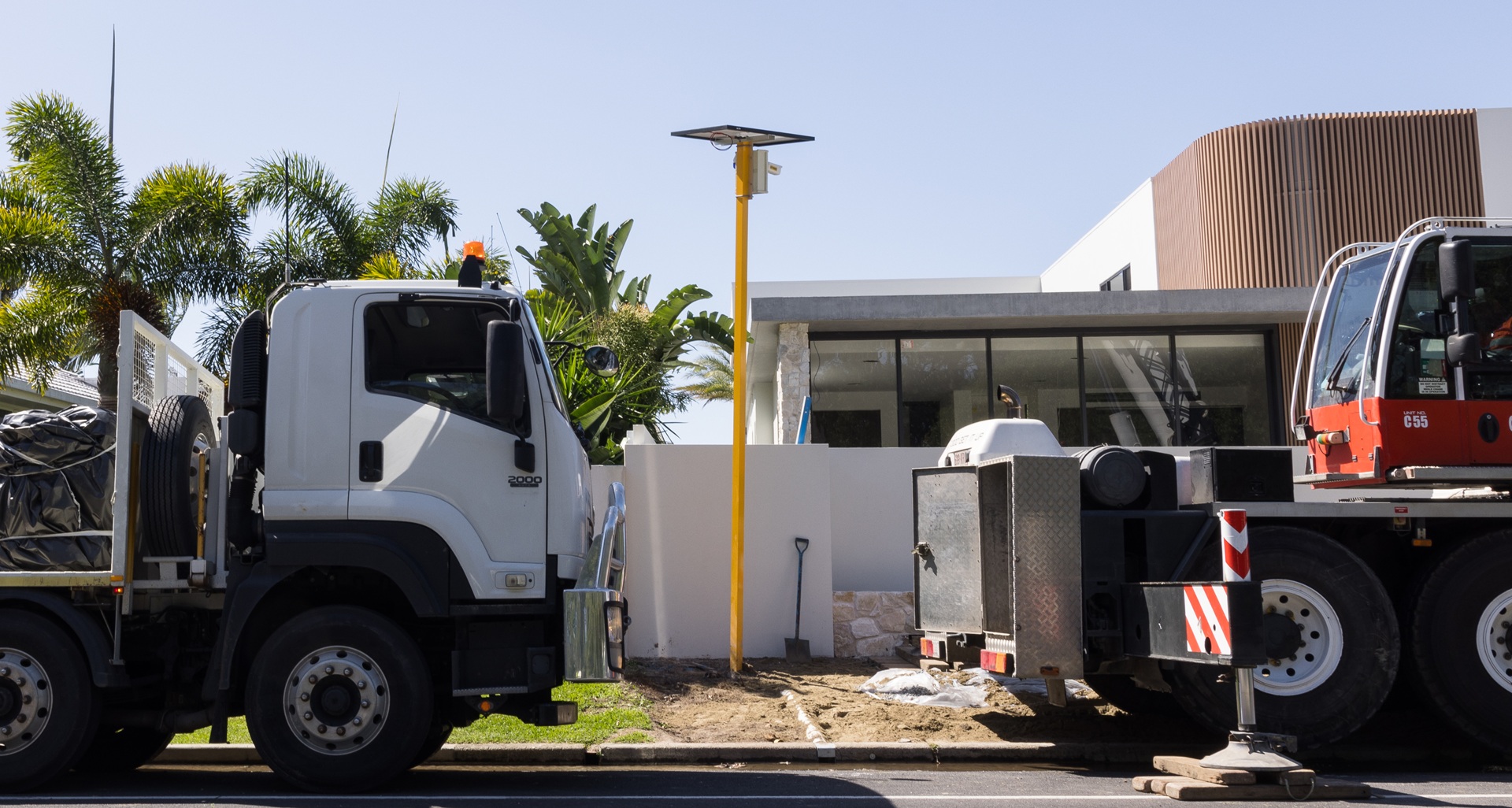
Since 2016, our construction site security systems have stopped thousands of break-ins on construction sites across Australia.
If you’re looking to learn more about how to prevent theft on construction sites with CCTV, we’ve listed our top 7 tips based on what we have seen work across active construction sites.
From our experience, the biggest mistake builders make is relying on CCTV purely as a recording tool.
By the time someone reviews the footage, the tools, materials or equipment may already be gone.
The best construction CCTV setups are built around three things:
- Deterrence
- Detection
- Response
Here is what we recommend.
1. Use CCTV That Can Detect a Theft Attempt, Not Just Record It
If theft prevention is your goal, we would not rely on cameras that simply record continuously and store footage for later.
We have seen plenty of sites where the cameras technically did their job. They captured the person entering, walking through the site and leaving with equipment.
The problem is that nobody knew it was happening at the time.
That is why we recommend active CCTV.
An active construction security system can detect unauthorised movement, generate an alert and allow a monitoring team to respond while the person is still on site.
In our experience, that difference is far more important than simply increasing camera resolution.
| Standard CCTV | Active Construction CCTV |
|---|---|
| Records site activity | Detects suspicious activity |
| Footage is often checked afterwards | Alerts can be generated in real time |
| Relies on someone reviewing footage | Can be professionally monitored |
| Helps investigate incidents | Can help interrupt incidents |
| Provides a visual deterrent | Combines deterrence, detection and response |
Sitesec takes this active approach to construction security. Our systems combine AI intruder detection, on-site alarms and a 24/7 Australian control room to identify suspicious activity quickly, deter intruders while they are still on site and coordinate a response before tools, materials or equipment can be taken.
Good construction CCTV should help stop the theft, not just show you how it happened.
2. Put Cameras Where Theft Is Actually Likely to Happen
Another mistake we regularly see is camera placement based on convenience rather than risk.
A camera might have a great view across the middle of a project, but that does not help much if the main vulnerabilities are the rear fence, tool container or vehicle access point.
When we assess a construction site, we generally look closely at:
- Site entrances and exits
- Vehicle access points
- Temporary fencing
- Blind spots around structures
- Tool storage
- Site sheds and containers
- Material laydown areas
- Plant and machinery
- Fuel storage
- Delivery zones
- Areas containing copper, appliances or fixtures
We also think about how someone would actually approach the site.
Where could they park?
Where could they enter without being seen from the road?
What could they carry away quickly?
Where are the most valuable items located after workers leave?
Those questions usually tell you far more about where cameras should go than simply trying to achieve blanket coverage.
Your Camera Positions Should Change as the Project Changes
Construction sites are not static.
What works during the early stages of a project may not work once walls go up, fencing moves or new materials arrive.
We recommend reviewing camera positions throughout the build.
We often reposition systems as projects progress because new structures can create blind spots and the highest-risk areas can change significantly from one stage to another.
3. Make Your CCTV Obvious
There is a common assumption that security cameras should always be discreet.
For construction theft prevention, we generally prefer the opposite.
If someone considering entering the site can clearly see security cameras, warning signage, lighting and alarms, that may be enough to make them reconsider.
From our experience, the best outcome is not catching someone.
It is convincing them not to try in the first place.
That is why we think construction CCTV should work across three stages:
- Deter. Make the site look harder and riskier to target.
- Detect. Identify unauthorised activity as quickly as possible.
- Respond. Take action while the person is still on site.
We also recommend audible alarms and good lighting as part of a broader construction site security strategy.
4. Make Sure Someone Is Watching When Your Team Goes Home
Most construction teams are already paying close attention to the site during working hours.
The greater security problem usually begins after everyone leaves.
Nights, weekends, public holidays and shutdown periods create long windows where a site may appear unattended.
In our opinion, this is where monitored CCTV provides its greatest value.
A camera on its own cannot decide whether someone walking through the site is a subcontractor, security guard or intruder.
A properly configured monitoring system can help close that gap.
At Sitesec, when suspicious activity is detected, our control room can review the live footage and determine whether there appears to be a genuine threat.
From there, the system can activate on-site deterrents and escalate the response where required.
That process matters because every minute counts during a break-in.
The longer someone can move around a site without being challenged, the greater the opportunity they have to find something worth taking.
Know Where Your Site Is Most Exposed
One of the easiest ways to improve construction site security is to look at the project through the eyes of someone trying to break into it.
Where would they enter?
What would they target?
Where could they move without being seen?
Sitesec can assess your site layout, access points, plant areas, storage zones and monitoring requirements and recommend a security setup around those risks.
5. Do Not Rely on Permanent Power or Site Wi-Fi
We rarely recommend treating construction CCTV like a permanent commercial security installation.
Construction environments change too quickly.
Sites may have limited power during the early stages of a build. Fixed internet may not exist yet. Access routes move. Buildings go up. Cameras may need to be relocated several times.
For this reason, we generally prefer self-contained camera systems that can operate independently.
Solar power reduces reliance on permanent electrical infrastructure.
4G connectivity removes the need to wait for a fixed internet connection.
That combination means cameras can be installed earlier and moved more easily as the project develops.
From our experience, this flexibility becomes particularly valuable on:
- Greenfield developments
- Large residential projects
- Civil construction sites
- Remote sites
- Temporary compounds
- Projects with changing work zones
Sitesec systems use solar power and 4G connectivity for exactly this reason.
We want the security system to adapt to the construction site, rather than forcing the construction site to adapt to the security system.
6. Make Sure the Footage Is Actually Useful
We spend a lot of time talking about preventing theft because that should be the priority.
There are still situations where recorded footage becomes important.
If something happens, you want to be able to work out:
- When the person entered
- Where they came from
- Which areas they accessed
- What they took
- How long they were on site
- Whether a vehicle was involved
- When they left
This is why we recommend looking beyond the headline resolution when comparing systems.
The more important question is:
Can you clearly understand what happened under the conditions your site actually experiences?
That includes night-time conditions.
It also includes how easy the footage is to access.
We would avoid any setup where reviewing an incident means visiting the camera physically or spending hours scrolling through recordings.
Remote access makes the process much easier.
Our Sitesec Capture system provides 4K recording, cloud storage and remote viewing so authorised team members can check activity without needing to be on site.
That can also be useful outside security incidents.
Project managers can remotely check site conditions, deliveries and activity without making another trip to the project.
7. Do Not Expect CCTV to Fix Weak Site Security
CCTV works best when the rest of the site is also difficult to access.
We would never recommend installing cameras and then ignoring basic physical security.
Some of the most effective theft-prevention measures are also the simplest:
- Lock gates after hours
- Maintain secure fencing
- Keep valuable tools out of sight
- Lock equipment inside secure containers
- Record serial numbers
- Control site access
- Keep track of material deliveries
- Maintain lighting around vulnerable areas
We think about these measures as layers.
A fence slows someone down.
A locked container creates another barrier.
Lighting makes them more visible.
CCTV detects their movements.
Monitoring allows someone to respond.
The goal is to keep adding friction until the site becomes a poor target.
What We Look for in Construction Site CCTV
After working across construction projects, we think there are several capabilities that matter much more than flashy specifications.
| CCTV Capability | Why We Value It |
|---|---|
| AI intruder detection | Helps identify unauthorised movement quickly |
| 24/7 monitoring | Provides oversight after the workforce leaves |
| On-site alarms | Can immediately discourage an intruder |
| Remote viewing | Gives project teams visibility without being on site |
| Solar power | Reduces dependence on permanent electricity |
| 4G connectivity | Avoids relying on site Wi-Fi |
| Strong night vision | Maintains useful coverage after dark |
| Flexible installation | Allows cameras to move as the project develops |
| Recorded footage | Provides evidence if an incident occurs |
| Control room response | Turns detection into action |
If we had to prioritise one thing, it would be the response process.
Plenty of cameras can record an intruder.
The important question is what happens next.
Stop Construction Site Theft Before Equipment Leaves the Gate
If there is one thing we would recommend after years of working with construction sites, it is to stop thinking about CCTV purely as a recording system.
The best setups make the site harder to target, identify unusual activity quickly and allow someone to respond while the incident is still happening.
That requires the right camera positions, reliable connectivity, effective monitoring and a clear response process.
Sitesec provides temporary construction site security systems for residential, commercial, civil and mining projects across Australia.
Our systems combine AI intrusion detection, 4K vision, solar power, 4G connectivity, on-site alarms, remote access and 24/7 control room monitoring.
If you are unsure what your project needs, our team can review your site layout, risk areas and monitoring requirements and recommend a setup based on what we would use to protect the site ourselves.
Get a quote today and protect your site before the next theft attempt.